
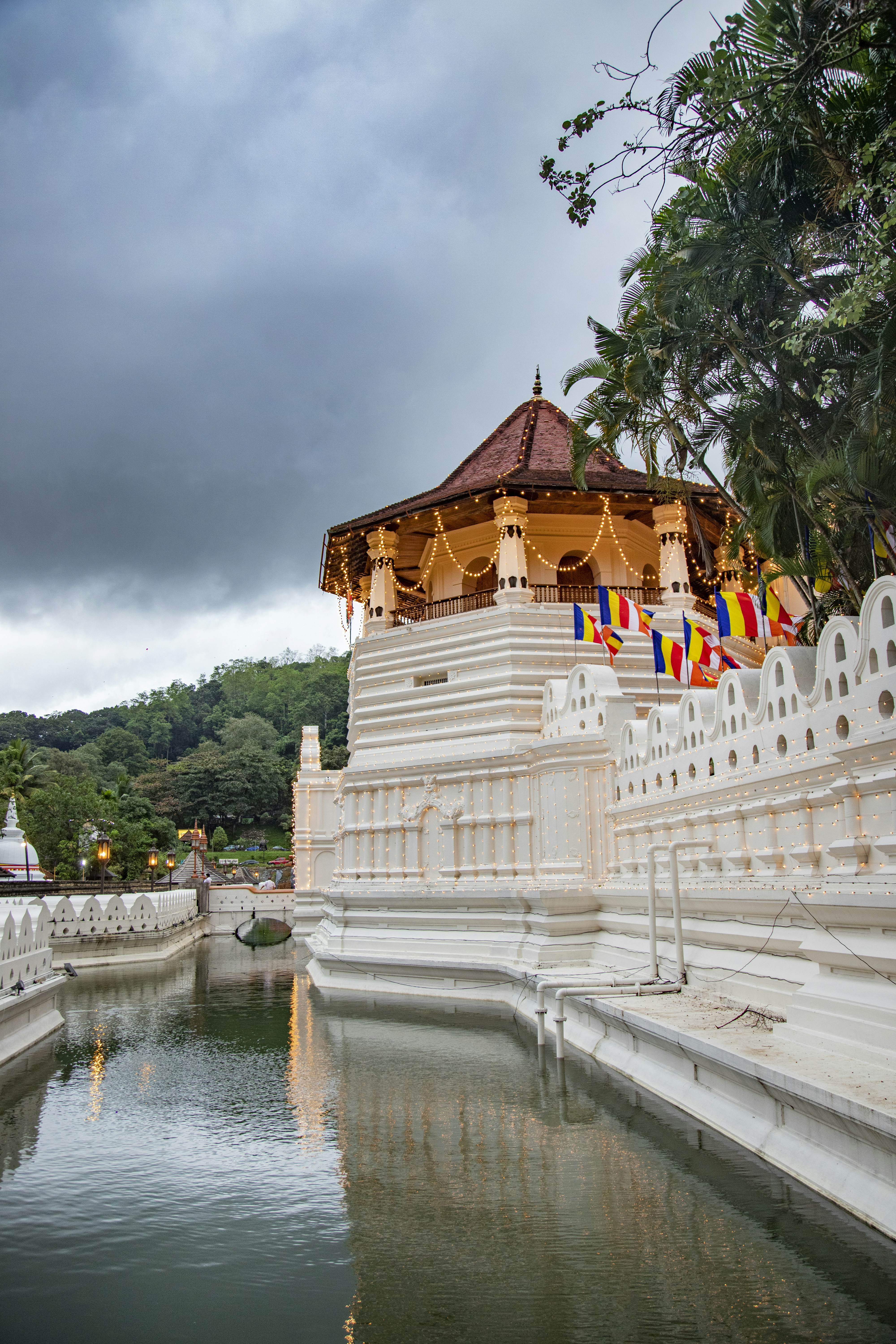
Kandy sits at around 500 metres above sea level in the central highlands. After a few days on the coast, the temperature drop when you arrive is noticeable — cooler air, mist in the hills in the morning, a completely different pace.
It was the last capital of the Kandyan Kingdom, the last part of Sri Lanka to fall to British rule, and the cultural heart of the country in a way that Colombo, for all its energy, isn’t quite. UNESCO inscribed it as the “Sacred City of Kandy” in 1988 — World Heritage Site number 450 — recognising the temple, the royal palace complex, the surrounding shrines, and the lake as a single living religious landscape. The Temple of the Tooth is here. So is one of the great botanical gardens in South Asia, and the edge of the Knuckles Mountain Range starts just to the east.
The Temple of the Tooth
The Sri Dalada Maligawa — the Temple of the Tooth — houses a relic of the Buddha that has been in Sri Lanka for over 1,600 years. The original tooth relic arrived on the island carried in the hair of a princess from India, and has been the most sacred object in Sinhalese Buddhism ever since. Whoever held the relic held the right to rule — which explains why the temple is where it is and why it’s built the way it is.
You can visit the temple compound during the day and watch the puja ceremonies, which happen three times daily. The inner shrine where the relic is housed is richly decorated and usually surrounded by offerings. It’s a functioning place of worship, not a museum, and it feels like one.
Kandy Lake
The lake in the centre of Kandy was built by the last king of Kandy, Sri Vikrama Rajasinha, in 1807 — just over a decade before the British arrived and the Kandyan Kingdom ended. He conscripted local labour to build it, which didn’t help his standing; the British used that resentment against him when they moved to take the kingdom in 1815. The lake sits directly below the Temple of the Tooth, which wasn’t accidental — controlling the relic and the water were both part of how the last Kandyan king projected power.
The walking path around the lake takes about 40 minutes at an easy pace. Go in the evening: the whole city comes here to end the day — families, monks, young couples, vendors. It’s where Kandy shows you its ordinary life rather than its tourist face.
The Royal Botanical Gardens, Peradeniya
About 5km outside the city, Peradeniya is one of the largest botanical gardens in Asia — 147 acres of trees, plants, and pathways. The avenue of royal palms alone is worth the trip. The garden has been here since the 14th century in various forms; the current layout was established under the British.
I prefer visiting in the morning when it’s cool and less crowded. There are sections most visitors miss that are worth finding — orchid houses, a fernery, spice gardens. I know the routes.
Kandyan dance
Kandyan dance is Sri Lanka’s most distinctive performing tradition — high-energy, acrobatic, performed in elaborate gold, red, and white costumes with a tall decorated headdress, accompanied by live geta bera drumming. The tradition traces back to the Kohomba Kankariya, an ancient ritual originally performed by Indian shamans and adapted over centuries into the ceremonial form used in the Perahera processions. It was historically performed by a hereditary caste of dancers aligned to the Temple of the Tooth — not casual folk art, but a formal practice with a specific lineage.
The Kandy Lake Club runs nightly cultural shows at 5:30pm near the Temple of the Tooth. It’s a staged performance rather than a ceremony, but the drumming is live, the costumes are genuine, and for most people it’s worth an evening. If you’re here during Perahera, you’ll see it in its full context — but the Lake Club show is a good introduction regardless.
Kandy as a base
Kandy is well-positioned for day trips that get you off the obvious path. The Knuckles Mountain Range starts a short drive east of the city and is among Sri Lanka’s most dramatic hiking country. Tea country — Nuwara Eliya, the estates around the Bogawantalawa valley — is 2 hours south. Dambulla and the cultural triangle are 2 hours north. If you’re spending more than one day, Kandy rewards using it as a base rather than a single stop.
The Esala Perahera
Kandy’s annual Esala Perahera is one of the largest Buddhist festivals in the world — ten nights of processions around the temple, with elephants, drummers, fire-dancers, and the casket containing the tooth relic carried through the city streets. It falls in July or August depending on the lunar calendar.
If you’re in Sri Lanka during Perahera, it’s worth attending at least once. The city is extremely crowded during this period and accommodation prices spike significantly — book well in advance.
What I show people in Kandy
The Temple of the Tooth and the puja ceremony — timing matters here, and the approach to the inner shrine changes depending on the crowds. I’ll take you when it’s right rather than when it’s convenient. Kandy Lake in the evening, when the city is using it. Peradeniya in the morning before the heat builds and the tour groups arrive. A Kandyan dance show at the Lake Club if the schedule allows. And if you’re here for more than two days, I’ll take you out of the city — into the Knuckles or down through the tea estates. Kandy is worth a day and a half; the country around it is worth more.
For food: Balaji Dosai is the most well-known restaurant in the city — 100% vegetarian, South Indian-style dosa, always packed because it’s earned it. Hela Bojun Hala is the local food court: hoppers, milk roti, jackfruit fritters, under a dollar a dish — this is where I go when I want to eat like a Kandyan. Theva Cuisine is the option for a proper dinner, with views of the surrounding hills.
FAQ
How long do you need in Kandy? A full day covers the Temple of the Tooth, Kandy Lake, and the market area in town. Two days is better if you want to include the botanical gardens and a day trip into the surrounding hills or the Knuckles. Three days turns Kandy into a comfortable base.
Is Kandy suitable for families? Yes. The temple is interesting for children who are old enough to understand what they’re looking at. The botanical gardens are spacious and easy to walk. Kandy Lake is pleasant for an evening stroll. The hill country’s cool air is a relief if you’ve been on the coast.
What is the difference between Kandy and Colombo? Colombo is a commercial port city — busy, modern, mixed. Kandy is older, more compact, and has held onto its character as a royal and cultural city. They feel nothing alike. Most visitors who spend time in both prefer Kandy.
Should I go to Kandy before or after the hill country (Ella)? Either order works. The train from Kandy to Ella through the tea estates is one of the best train journeys in Sri Lanka and it goes both directions. Many people do Kandy coming up from Colombo and Ella as the hill country midpoint before heading back to the coast or the cultural triangle.