
Most visitors treat Colombo as a transit point — a night before the flight, or an afternoon between the airport and the south coast road. That’s a mistake. Colombo is a proper city, one of the more interesting ones in South Asia, and a half day with someone who knows it well shows you a very different place from the one you’d see from a transfer vehicle.
The Fort and Pettah
The Fort district is where the city’s colonial history is most visible. The Portuguese built the original fortifications here in the 16th century; the Dutch expanded them in the 17th; the British took over in the early 19th century and left behind the neo-classical and Victorian buildings that still line the streets. The fort itself is long gone, but the architecture it protected remains.
The Dutch Hospital — dating to 1681, built to serve the Dutch East India Company’s officers and staff — is one of the oldest surviving structures in the Fort. Five wings around two internal courtyards, designed to manage the tropical heat. It was restored in 2011 and now houses some of Colombo’s better restaurants and cafés. The building is worth seeing on its own terms; lunch here is a good use of the midday heat.
Pettah, directly adjacent to the Fort, is a different world — a dense, loud bazaar that has been the city’s main trading district since the Dutch period. Each street specialises in something different: electronics in one lane, textiles in another, fresh produce, spices, hardware. Pettah is genuinely chaotic. I know the routes that make it navigable and interesting rather than overwhelming.
The Red Mosque
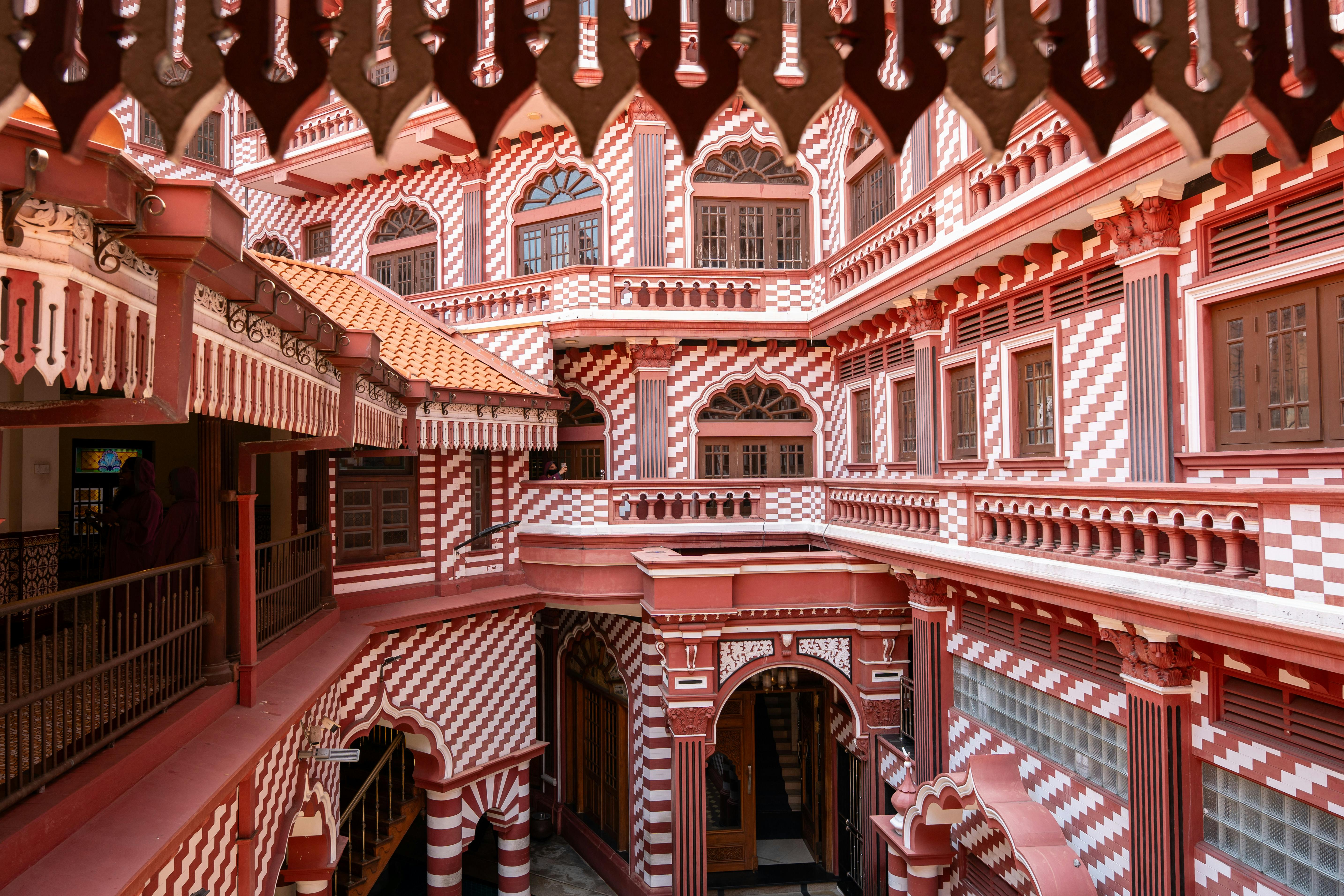
Standing in the middle of Pettah, the Jami Ul-Alfar Mosque is one of the most distinctive pieces of architecture in Colombo. Completed in 1909 and designed by Habibu Saibu Labbe — who had no formal architectural credentials — it combines Indo-Saracenic, Gothic, and neo-classical elements in a candy-striped red and white exterior with pomegranate-shaped domes. It shouldn’t work as well as it does.
Gangaramaya Temple
Founded in the late 19th century on the edge of Beira Lake, Gangaramaya is an active Buddhist temple complex — not a museum piece. It has a library, a museum of donated artefacts, and an eclectic collection of objects given to the temple by devotees over more than a century: antique vehicles, ivory tusks, Buddha statues from every Buddhist country in Asia. It rewards an hour of serious attention.
The temple also organises the Navam Perahera — one of Colombo’s largest annual festivals, held in February, with elephant processions around Beira Lake.
Galle Face Green
The seafront promenade running south of the Fort is where Colombo comes in the late afternoon. Kite sellers, street food vendors, families spread across the grass, the Indian Ocean going orange as the sun drops. It’s a good place to end a city day — the street food here is cheap, specific to Colombo, and worth eating: isso vadai (prawn fritters), kottu roti made to order, fresh thambili (king coconut straight from the shell).
What a city sightseeing trip looks like
A half-day route covers the Fort district, the Dutch Hospital, into Pettah and the Red Mosque, and Gangaramaya — three to four hours. A full day adds Cinnamon Gardens, the National Museum, and ends at Galle Face for the sunset and the street food.
Most people visit Colombo either at the start of their trip — arriving from the airport — or at the end, before flying home. Either works. I can meet you at your hotel, plan the route around your timing, and show you the city that exists beyond the transfer corridor.
Getting around
Colombo’s traffic is serious. The Fort and Pettah are walkable; elsewhere a tuk-tuk or car makes more sense. I handle the logistics — you don’t need to think about it.
FAQ
Is Colombo worth spending time in? More than most visitors assume. The Fort, Pettah, and Gangaramaya alone justify a half day. If you’re passing through on the way to the south coast or the hill country, it’s worth building in a few hours rather than treating the city as a corridor.
How long does a city sightseeing trip take? A half day (3–4 hours) covers the Fort, Pettah, the Red Mosque, and Gangaramaya. A full day adds Cinnamon Gardens, the National Museum, and Galle Face at sunset. I’ll plan it around your arrival time, flight, or onward journey.
Is Colombo safe to walk around? Yes. The Fort and Pettah are busy during the day and entirely safe. Pettah can feel disorienting at first — it’s genuinely dense — but with a guide it’s navigable. Colombo has no particular safety concerns for visitors.
Can I combine a Colombo city trip with the south coast? Yes — Colombo to Galle is about 2.5 hours on the Southern Expressway. I sometimes run routes that start with the city in the morning and continue to the south coast in the afternoon, which makes good use of a travel day.
Want to visit Colombo?
WhatsApp Kanishka to plan your trip. Tell him when you're coming and what else you'd like to see — he'll work out what's possible.
WhatsApp Kanishka about Colombo